
Stability Testing and the Travel Retail Timeline: Where Lead Times Go
Lead times in a travel retail launch are rarely lost in production. They are lost in the sequence of decisions that has to happen before production can begin, and the longest of those is usually the testing and documentation window rather than the compounding or the filling. A schedule built backwards from the shelf date tends to look comfortable until someone notices that the stability work cannot start until the pack is fixed, and the pack cannot be fixed until the artwork is decided. Buyers who map the dependencies rather than the durations are the ones whose launches arrive on time.
Key takeaways
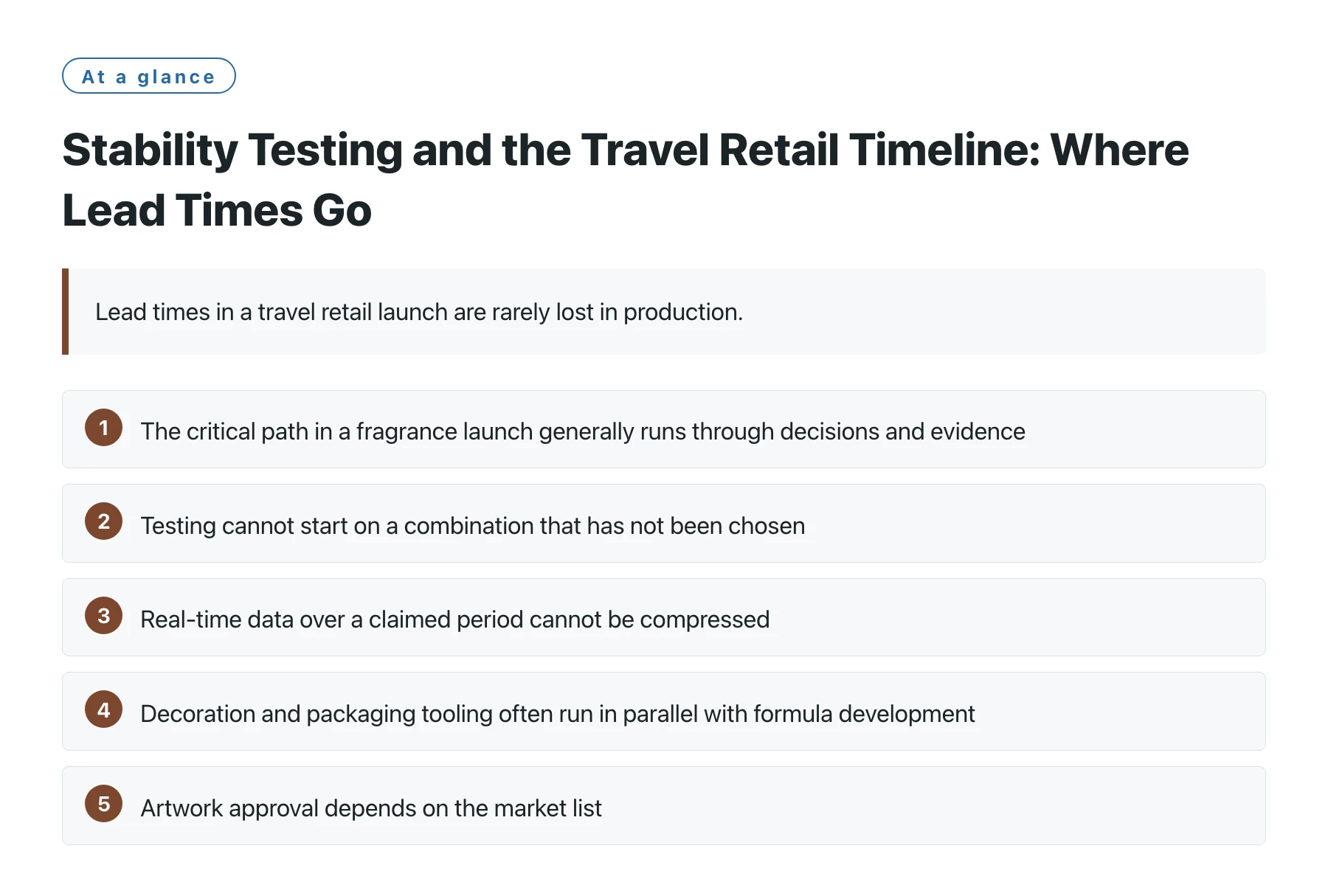
- The critical path in a fragrance launch generally runs through decisions and evidence, not through machine time.
- Testing cannot start on a combination that has not been chosen, which is why pack and market decisions move the calendar more than any production step.
- Real-time data over a claimed period cannot be compressed, so the claim has to be set against the schedule rather than the other way round [1].
- Decoration and packaging tooling often run in parallel with formula development, and treating them as sequential is a common and expensive assumption.
- Artwork approval depends on the market list, so a market list settled late will delay printing regardless of how early the design began.
- A supplier's own capacity position is a scheduling input, and it is reasonable to ask when the line slot is reserved rather than when production is expected to finish [2].
Two launches with the same shelf date can have very different calendars depending on decisions made in the first fortnight. One fixes the pack list, the market list and the claim immediately, which allows testing, tooling and artwork to proceed together. The other keeps options open, which feels flexible and behaves like a queue: every later stage waits for an earlier decision that has not been made.
It helps to think of the schedule as a set of dependencies dressed up as durations. Most of the stages in a launch have a natural length, but their position in the calendar is determined by what they wait for. Moving a dependency earlier is almost always cheaper than shortening a duration.
The table below sets out the stages that determine a travel retail schedule and, more usefully, what each one can run alongside.
The stages that set a travel retail schedule
| Stage | What sets its length | What can run alongside it |
|---|---|---|
| Brief and concept | How quickly the brand can commit to a direction and a price position | Early conversations with packaging and decoration suppliers |
| Formula development and selection | The number of directions explored and how quickly feedback returns | Pack shortlisting, artwork direction, market list definition |
| Pack and component selection | Stock availability for standard components, or tooling time for custom ones | Formula refinement and early material eligibility checks |
| Artwork and market review | The market list being final, and the number of markets that require specific statements | Stability and compatibility work on the frozen combination |
| Stability and compatibility testing | The conditions used and the period the claim requires, with real time as the immovable element | Decoration trials, carton production, quality documentation preparation |
| Decoration and assembly preparation | Vendor slots for coating, frosting, print or foil, which are often the least flexible items | Bulk compounding once the formula is released |
| Bulk production and fill | Line availability and the released specification | Final documentation assembly and shipping preparation |
| Documentation and listing handover | How quickly the record pack can be assembled and reviewed | Freight booking and retailer onboarding |
The middle column explains why two projects with similar scopes finish months apart. The right-hand column explains what a well-run project does differently: it fills the waiting time of one stage with useful work from another.
Why the critical path moves to testing and documentation
Production is the most visible part of a launch and usually the shortest. Compounding and filling a batch is a matter of days once the specification is released. The parts that stretch are the ones that cannot begin until something else is decided, and the claim-supporting work sits at the end of that chain because it depends on the formula and the pack at the same time.
Documentation has the same property. A record pack cannot be assembled before the results exist, and results cannot exist before the combination is frozen. This is why documentation problems surface so late and feel so sudden: they are the tail of a sequence that started with an unfixed decision.
Testing is also the one stage where honesty about duration matters. Real-time data covering a claimed period takes that period, and no supplier can shorten it. A programme can be planned so the claim matches what will be available at print, but it cannot be planned so the evidence arrives faster than the chemistry allows [1].
Parallel work is the main source of slack
The most useful scheduling question is what can be done while something else is pending. Decoration trials, carton production and documentation templates do not need the final formula, and formula refinement does not need the final artwork. Projects that treat these as a queue lose weeks that were never necessary.
Ask about capacity, not only about duration
A quoted lead time is a commitment about sequence, not about a specific slot. It is reasonable to ask when the production window is reserved, how a reorder would be scheduled, and what happens to the slot if a component arrives late. Manufacturers that manage production as a documented process will usually answer these questions in operational terms [2], and the answers are more informative than a headline number.
Planning backwards from the shelf date
The practical method is to start at the date the product must be on the fixture and work backwards through the dependencies, not the durations. Documentation handover comes first, then shipping, then fill, then release, then the testing window, then pack and artwork decisions, then formula selection. Each arrow in that chain is a dependency that has to be closed, and the earliest ones are decisions rather than activities.
Two habits make this workable. The first is fixing the pack list and the market list in the first fortnight, because almost every later stage depends on them. The second is asking a prospective partner for their view of the schedule, including where they expect the risk to sit. A manufacturer that has run travel retail projects will usually name decoration and testing as the two areas to watch, and will ask how early the market list can be frozen. That question is itself a useful signal.
The perspective of an established producer helps here, since a factory that has been through many launches tends to plan backwards by habit rather than by instruction. Buyers who want to see how production capacity and scheduling are described by a manufacturer with a long history can look at Xuelei Fragrances and production capacity and lead times side by side, then ask the same questions of whichever partner they are considering.
When a schedule is under pressure, cut scope rather than sequence. Dropping one format, moving one finish to a second run, or claiming a slightly shorter period will save time predictably. Attempting to run the testing window after production, or to print before the market list is settled, converts a manageable delay into a rework that cannot be scheduled away.
Sources
- EU Scientific Committee on Consumer Safety (SCCS) —— The EU scientific committee that issues opinions on the safety of cosmetic ingredients, including fragrance allergens and their labelling thresholds.
- Cosmetics Europe —— The European trade association for the cosmetics and personal care industry, publishing guidance, positions and market information.
Frequently asked questions
What is usually the longest stage in a fragrance launch?
The claim-supporting testing window, because real-time data cannot be compressed. Development and selection can often be accelerated by narrowing the brief, and decoration can be parallelised, but a shelf-life claim covering several years requires the corresponding period of evidence. Planning around that constraint early is what protects the shelf date.
Can decoration and formula development happen at the same time?
Yes, and they usually should. Decoration trials and packaging production depend on the pack choice rather than on the final formula, so they can proceed while the scent is being refined. The dependency to respect is between decoration and compatibility testing: the pack has to be frozen before the combination can be tested.
How early should the market list be fixed?
Before artwork approval, and preferably before the pack list is final. Labelling statements and notification obligations vary between markets, and one unit sold in several places has to satisfy the strictest requirement. Fixing the list late turns a scheduling problem into a reprint and, in some cases, into a re-labelling exercise on finished goods.
Does a shorter lead time mean a worse product?
Not necessarily, because much of a lead time is waiting rather than working. Projects compress well when decisions are made early and parallel work is used properly. What does not compress is evidence, so a compressed schedule should lead to a smaller and more honest claim rather than to a thinner evidence base.
What should a brand ask a manufacturer about scheduling?
Ask when the production slot is reserved, which stages the manufacturer considers most likely to slip, how orders are sequenced when components arrive late, and what the position is on repeat orders. The answers describe how the factory actually operates, which matters more than a headline lead time quoted for a general project.
Publish with editors, not algorithms.
Vetted writers, 12-point QA, same-day turnarounds.