
Brass Jewelry Manufacturing for Fashion Collections
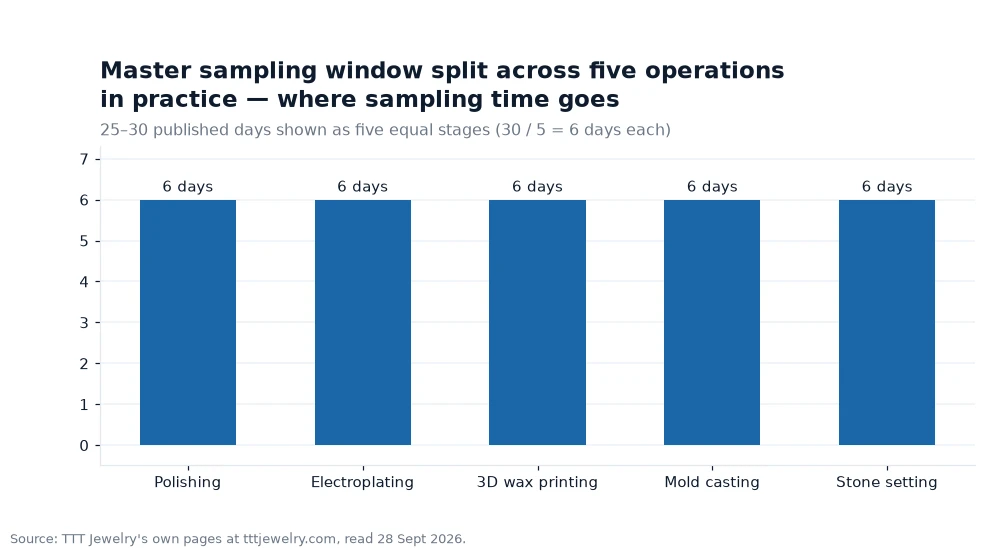
A fashion collection is sold on a date, not on a season, and that forces the schedule to run backwards from launch day. A first brass order takes about 7 to 9 weeks from approved drawing to shipped carton — 2 days of CAD, 25–30 days of sampling and 21–28 days of production — against a minimum of 100 pieces per design in artisan eco-brass. Design changes after sampling restart the clock.
Key takeaways
- A first brass collection takes roughly 7–9 weeks from approved CAD to delivery, excluding your own approval time.
- Six customisation options are offered per order, from base metal and plating through to packaging and barcodes.
- Plating choices are 14K, 18K or 24K gold and rhodium, all over an anti-tarnish e-coating on brass.
- Eco-brass starts at 100 pieces per design, so a drop of six styles is a 600-piece commitment at minimum.
Why fashion drops buy differently from precious-metal ranges
A bridal or heirloom line can be planned two seasons ahead and reordered for years. A fashion drop lives eight to twelve weeks and depends on being on the shelf while the trend is still visible. The result is that a fashion buyer cares less about the last percentage point of finish quality and much more about whether the carton lands on a specific date.
That inverts the usual priorities. Where a silver collection asks which minimum keeps the most designs alive, a fashion collection asks how many styles can be tooled in parallel and which ones can be cut without losing the story of the drop. Both questions are answered by the same three published windows, read in a different direction.
Building a drop calendar backwards from launch day
Start at the shelf date and subtract. Production is 3–4 weeks, so the sample has to be approved a month before the drop; sampling is 25–30 days, so the design has to be signed off six to seven weeks before the drop; CAD is under 48 hours, so the drawing needs to be finalised seven and a half weeks out. That leaves a first order at roughly 7–9 weeks total, before packaging runs are counted.
What a fashion buyer can control is the two approval gates rather than the three published windows. CAD comes back in under 48 hours and sits on someone's desk for four days; the sample arrives and waits a week for a decision. Those gates are free to shorten and they are the only part of the calendar the brand owns outright.
Trend changes inside a tooling cycle
Trends move faster than moulds. Once a design is tooled, the shape is fixed, but the finish is not: 14K, 18K and 24K gold and rhodium are all plating choices, and a colour change does not need a new mould. A drop that is half gold and half rhodium can therefore be rebalanced after the sample without touching the tooling.
Stones and accents are the second lever, because natural stones and freshwater pearls are specified rather than tooled. Where a design allows for an accent that can be changed, the same casting can carry two looks across two drops. The finish list itself is published at www.tttjewelry.com/custom-brass-jewelry/, next to the coating detail. What cannot move after tooling is the geometry — so a fashion collection usually takes its risk on the shape it believes in and keeps its flexibility in colour, stone and packaging.
| Item | Published figure | Effect on a drop calendar |
|---|---|---|
| 3D CAD modelling | Under 48 hours | Shape changes stay cheap until sign-off |
| Master sampling | 25–30 days | Sets the six-to-seven week mark before launch |
| Mass production | 3–4 weeks | Runs after sample approval, not in parallel |
| Eco-brass minimum | 100 pcs per design | Six styles means 600 pieces minimum |
Packaging is part of the drop, not an afterthought
Gift boxes stamped in foil, metal logo tags, labelling with barcodes, backing cards for display and velvet/microfiber pouches are all outside the jewelry production line, and each is produced in its own run. For a fashion drop this is where dates slip quietly: the jewelry is finished, inspected and sitting in the factory while the printed backing cards are still on a press.
The fix is to treat the packaging as a second critical path. Start the boxes and cards with the CAD file rather than after the sample approval, and specify the barcode or SKU structure at the same time, because a label reprint at packing stage means unpacking cartons that had already been closed.
How the MOQ shapes a first seasonal order
The MOQ by base material is 50 in the silver line, 100+ pieces in stainless work and 100 pieces in artisan brass, counted per design, which doubles again for a two-design range. For a six-style drop that is a 600-piece minimum in brass, all of it committed before a customer sees any of it. Fashion brands usually answer this by narrowing the first drop and widening the second, once the styles that sell have shown themselves.
The alternative is a mixed-material drop, which changes the maths but adds a specification line. Silver carries the lower floor at 50 pieces per design, so a two-metal collection can be tooled with less total commitment — at the cost of running two finishing routes, because silver and brass share the wet plating tank and anti-tarnish e-coating while stainless steel goes through PVD instead.
Antique finishes, skin comfort and the recyclable line
A trend-driven collection has one more finish lever than the bright plating list suggests: oxidation and antique finishes are published alongside gold and rhodium. For a drop built on a vintage or hand-worked look, that is the difference between a piece that fits the story and a plated version of it — and it does not need a new mould to introduce.
Two other published points travel well in fashion retail. The plating layers on brass are described as a durable barrier suitable and comfortable for most skin types, and the metal is stated as 100% recyclable, with REACH and California Prop 65 conformity and nickel content meeting certified standards. Those are sentences a buyer can put in front of a stockist without commissioning a report first.
Worked example: what a late design change costs a drop
Take a drop with a shelf date nine weeks out. The published chain fits almost exactly: 0.3 weeks of CAD, 4.3 weeks of the slow sampling window and 4 weeks of production come to 8.6 weeks, leaving about three days of margin. That is the whole buffer for a nine-week drop.
Now suppose the shape changes after the first sample. Sampling does not carry over; the same five operations run again, so the schedule becomes 8.6 + 4.3 = 12.9 weeks and the drop misses its date by nearly four weeks. Alternatively, change only the finish: plating is one of the eight factory steps, so re-plating an existing sample is a single operation rather than a second full sampling cycle. My arithmetic; the windows and the eight-step count are the published ones.
Frequently asked questions
How far ahead of a drop should a brass collection be ordered?
Nine weeks before the shelf date for a first order, which covers under 48 hours of CAD, 25–30 days of sampling and 3–4 weeks of production.
Can a finish or colour be changed without retooling?
Yes. Plating in 14K, 18K, 24K gold or rhodium is a finish choice, so a colour change after sampling does not require a new mould.
What is the smallest viable first drop?
One style at 100 pieces in eco-brass, or 50 pieces per design in 925 sterling silver, which is the lower published floor of the two.
Ordering a drop so it lands on the date
Freeze the shape at CAD approval, keep the flexibility in colour, stones and packaging, and start the packaging run at the same moment as the drawing rather than after the sample. Then watch the two gates you own: a sample that sits unread for a week has taken seven days off a nine-week drop. Ask for the five sampling operations and the eight production steps by name, so a delay can be attributed to a stage rather than to the order as a whole. A two-metal collection is worth planning in the same message — the OEM and ODM routes set out which one fits a brand arriving with drawings, and the wholesale and custom page covers multi-style runs.
Most of what this piece relies on — the 24-hour response commitment; the REACH and Prop 65 statements and the recyclable-brass statement — is set out on the factory's own site on tttjewelry.com (read 28 Sept 2026). The custom brass jewelry line is where the oxidation and antique finishes sit. The sums behind the example are my own working, and nothing else here [1]